Otus: a Smart Yield Account Powered by vaults.fyi
For Otus users, Smart Yield turns stablecoin yield into one simple experience. Behind the scenes, our API helps Otus access DeFi yield across protocols, keep funds productive, and track what each user is earning.

Otus (formerly Blueprint) is building a consumer finance app around a simple idea: give people one account that does the work of all of DeFi. Its Smart Yield account is live today, with more financial account types coming next. Under the hood, AI agents decide where funds should be deployed and when they should move. A user sets a goal, deposits funds, and the agent decides where to deploy and when to move.
The Smart Yield account is powered by vaults.fyi. Otus uses the API for yield discovery, transaction execution, and position tracking, so its team can focus on the agent logic and the consumer experience rather than on maintaining protocol integrations.
The Problem: DeFi Yield Is Too Fragmented for a Consumer Account
A yield account has to feel simple. The yield behind it is not. Returns are spread across dozens of lending markets, RWA products, and curated vaults, each with its own contracts, risk profile, and deposit flow. New pools launch constantly and rates move daily.
For an agent to manage a user's savings, it needs a single, current view of every option, a consistent way to assess risk, and a reliable way to execute. Building and maintaining that across protocols and chains is a full engineering effort on its own. Otus wanted that layer to be infrastructure, not a thing its team had to own.
How Otus Uses the vaults.fyi API
Discovery and Vault Data
Otus pulls live and historical APY and vault data across the protocols vaults.fyi covers on EVM, including Aave, Morpho, Fluid, and Spark. This gives the agent a complete, current menu of yield options without Otus integrating each protocol directly.
Using vaults.fyi with Privy
Otus uses Privy for embedded wallet infrastructure, and vaults.fyi fits into that setup as the DeFi yield layer. When the Otus agent decides to deposit, rebalance, or withdraw, vaults.fyi returns the transaction payload for the selected vault action, which Otus routes through its Privy-powered wallet experience for signing and submission.
This keeps wallet onboarding and signing separate from yield infrastructure: Privy supports the wallet experience, while vaults.fyi supports DeFi discovery, transaction payloads, position tracking, and attribution.
Risk Scoring and Curation
Otus uses vaults.fyi Reputation Scores to evaluate protocol health, network health, and vault-level history. The team filters that universe down to conservative, real-yield sources: tokenized T-bills and over-collateralized lending. The result is a whitelisted set of vaults the agent is allowed to use. Otus targets returns in the range a normal saver expects, around 6 to 7 percent, and treats anything beyond that as out of scope.
Transaction Payloads
When the agent decides to deposit, rebalance, or withdraw, vaults.fyi returns ready-to-sign transaction payloads. Otus signs and submits them. The moment a user deposits into the Smart Yield account, funds are deployed. The agent keeps the account from holding idle cash.
Position and Portfolio Tracking
vaults.fyi position and portfolio endpoints give Otus a unified view of where every user's funds sit and what they have earned, across all underlying protocols. The agent uses this to rebalance within the bounds each user has set, such as their target yield and how actively they want their funds moved.
Attribution and Monetization
Because Otus routes supported transactions through vaults.fyi, deposits can be attributed onchain to Otus. The vaults.fyi dashboard gives Otus reporting across attributed TVL by protocol and vault, with address-level detail available for reconciliation.
For supported curator and protocol relationships, vaults.fyi also tracks fee-share eligibility and settlement data. This gives Otus a cleaner way to monetize the savings product without building custom attribution, rebate tracking, or monthly reporting workflows for each protocol relationship.
Example User Flow
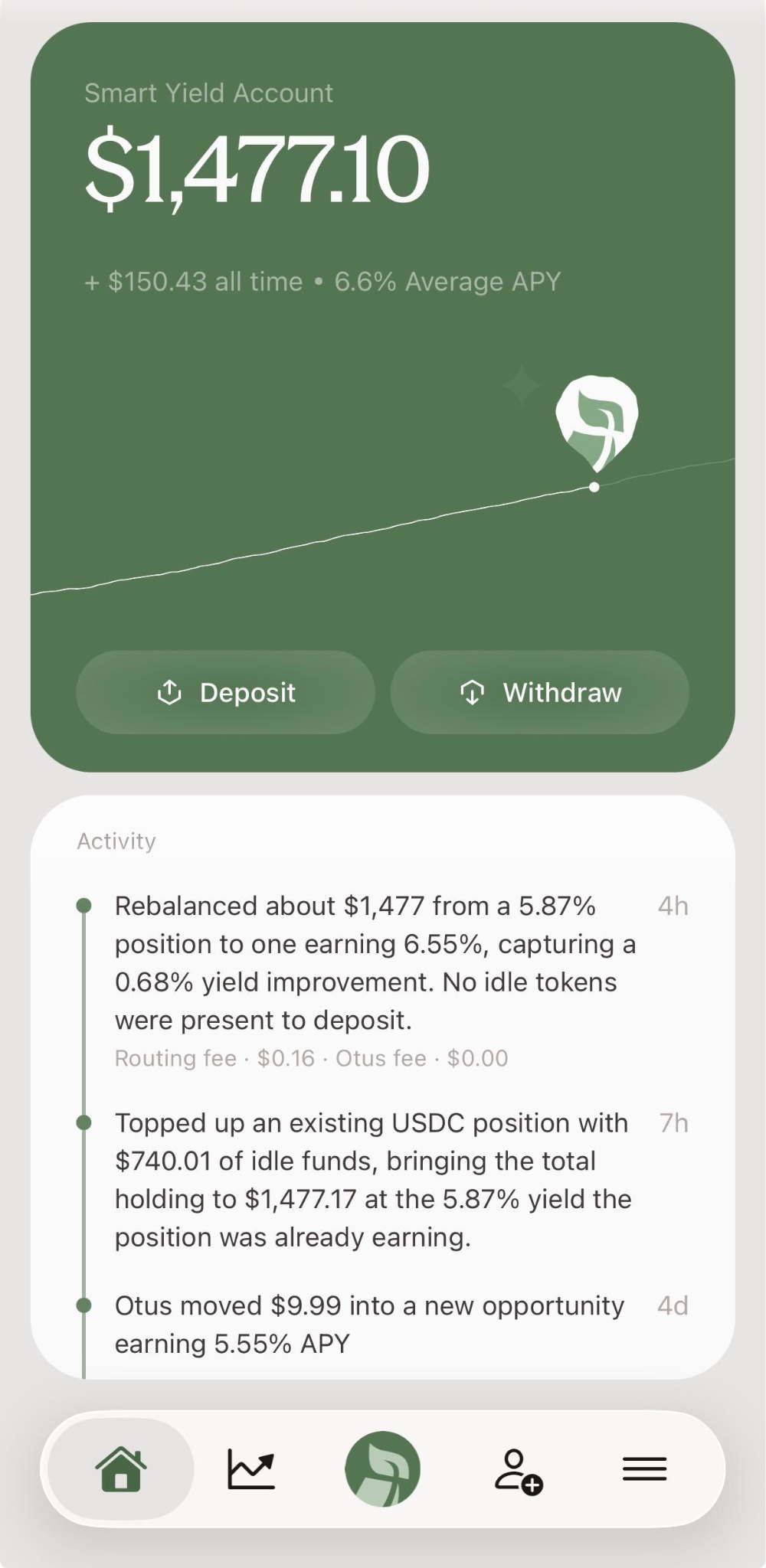
- A user opens an Otus Smart Yield account and sets their preferences, including target yield and how actively the agent should rebalance.
- They deposit stablecoins. The funds are deployed immediately into whitelisted vaults.
- As rates move, the agent rebalances within the approved set, keeping the funds productive.
- The user sees a single savings balance and yield. Otus sees full attribution and rebate revenue in the vaults.fyi dashboard.
Why Otus Built This with vaults.fyi
Otus wanted everything vaults.fyi offers, not a single protocol. The product depends on aggregating the full yield universe and letting an agent pick within it, so coverage, risk data, execution, and attribution all mattered from day one.
Building that in-house would have meant dozens of protocol integrations and ongoing maintenance, pulling the team away from the agent and the consumer experience that make Otus distinct. vaults.fyi gave them one account's worth of access to most of DeFi, with the risk data and monetization built in.
Why It Matters
"Our whole idea is to boil all of DeFi down to one account. vaults.fyi makes that possible. We get coverage, risk scoring, execution, and attribution from a single API, so our team can focus on the agent and the experience instead of maintaining protocol integrations."
- Meet Patel, Co-Founder, Otus
Want to offer DeFi yield in your own product? Get an API key at vaults.fyi.
Download Otus today: otus.io.