Add yield to your stablecoin product with vaults.fyi
Yield is becoming a feature users come to expect, and the market delivering it is evolving quickly.

Why offer yield at all?
Payments apps and fintechs that hold stablecoin balances on behalf of users are sitting on an obvious opportunity. Those balances are idle. DeFi lending markets pay 3-6% APY on USDC and USDT today, continuously, with no lockups. The gap between what users earn (nothing) and what the market pays is a product decision, not a technical constraint.
Users are noticing. As stablecoin-native financial products multiply, the baseline expectation is shifting: a dollar held in an app should earn something. Products that offer yield retain users better and attract deposits from users who would otherwise hold balances elsewhere. The ones that don't will increasingly look like a checking account in a world of high-yield savings.
The opportunity is clear. What has been less clear is how to build it without taking on a permanent maintenance obligation: tracking protocol upgrades, negotiating curator relationships, normalizing position data across chains. That is the problem vaults.fyi solves.
The integration problem
Adding yield to a stablecoin product sounds straightforward. Pick a protocol, integrate it, ship the feature. The problem is that picking a protocol commits you to that protocol's roadmap, its risk parameters, its curator relationships, and its chain preferences, often indefinitely.
When a protocol upgrades, you rebuild the integration. When a better curator launches a product on a different chain, you can't offer it. When yields shift and your single option is no longer competitive, users notice. The integration decision that felt simple on day one becomes a maintenance burden and a product constraint.
vaults.fyi is built to solve this. One integration gives you access to the full universe: across protocols, curators, chains, and assets, letting you configure the menu you show users however your business requires.
What to offer
Your earn feature should not show users a thousand vaults. It should show two or three, chosen by you, tailored to your user base.
The right number depends on the spread between your options. Two tiers often work well: a conservative option and a higher-yield one. Three tiers make sense when there is a genuinely distinct middle option: a different risk profile, a different protocol, or a different underlying asset.
The configuration is yours. You choose which curators to trust, which protocols to include, which assets to support, and how many tiers to present. vaults.fyi surfaces the vaults that fit those criteria and provides everything needed to display them and execute transactions. The examples below show how different integrators would configure this differently, based on their ecosystem relationships and customer demographics.
Sample product offerings
Each row below is a two-tier earn product set. Pick the one that fits your customer base and business needs, or choose preferred protocols and/or curators from the 1000+ vaults on our platform.
| Focus | Conservative | Higher Yield |
|---|---|---|
| Gauntlet (USDC) | Gauntlet USDC Prime · Morpho · 4.37% 30d | Gauntlet USDC Frontier · Morpho v2 · 4.89% 30d |
| Steakhouse Financial (USDC) | Steakhouse Prime USDC · Morpho · 4.37% 30d | Steakhouse High Yield Instant · Morpho v2 · 5.72% 30d |
| Sky ecosystem (USDS/USDC) | sUSDS · Sky SSR · 3.64% 30d | sky.money USDS Risk Capital · Morpho v2 · 4.60% 30d |
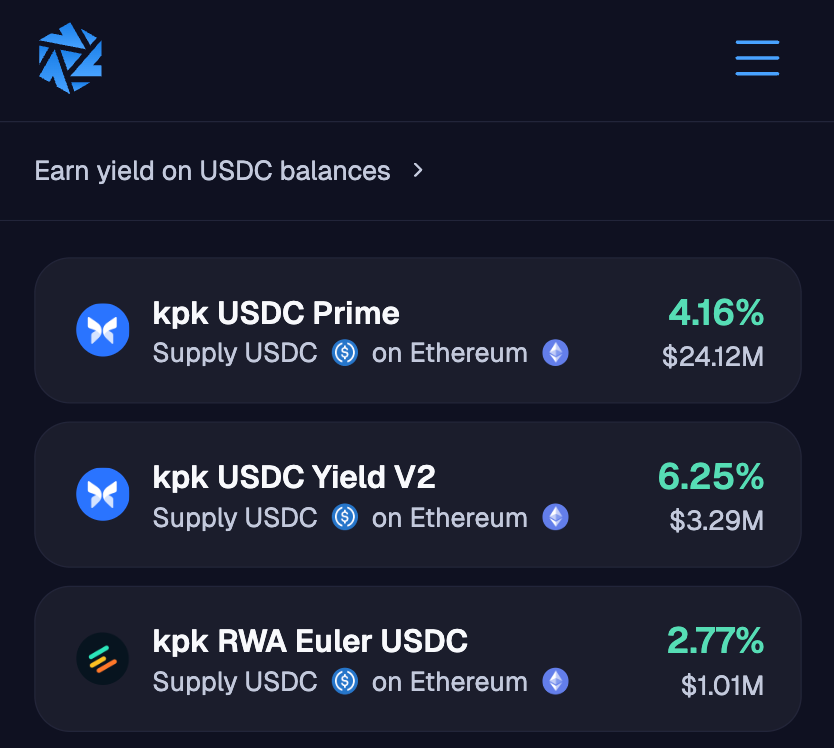
| KPK (USDC) | kpk USDC · Morpho v2 · 4.16% 30d | kpk USDC Yield V2 · Morpho v2 · 6.25% 30d |
| Aave (USDC) | Aave Horizon RWA USDC · Aave · 2.76% 30d | Aave v3 USDC · Avalanche · 5.66% 30d |
All APYs 30-day trailing as of June 2026 and will vary over time.
Let's take an example: KPK is a leading asset management firm in DeFi. A provider that prefers to work with KPK's products can offer yield products that span across two or more risk tiers.
Or, for providers that prefer staying within one protocol family, an Aave offering might give users choice between lower yield on Horizon (an institution-grade market built for KYC'd borrowers) and a higher yielding Aave USDC market on a different chain.
What users see
For each option in your earn feature, the vaults.fyi API returns the data you need to give users a clear, honest picture of what they are choosing between:
- The rate. 30-day trailing APY, with base yield and any token rewards shown separately so users understand what is organic and what is incentivized.
- Who manages it. The curator (e.g. Gauntlet, Steakhouse Financial, KPK) and the protocol where funds are deployed. Users can look these up; naming them builds trust.
- Scale and track record. Total deposits in the vault and how long it has held significant funds. A vault with $400M in deposits and two years of history is a different proposition from one with $5M and six months. Every vault carries a Reputation Score: an objective, on-chain composite covering vault history, holder distribution, asset quality, and protocol track record, so you can filter programmatically rather than curate by hand.
- Active risk flags. If a vault is exposed to a security incident or under review, that flag surfaces before the user deposits, not after. You can suppress flagged vaults from your menu programmatically or show a warning.
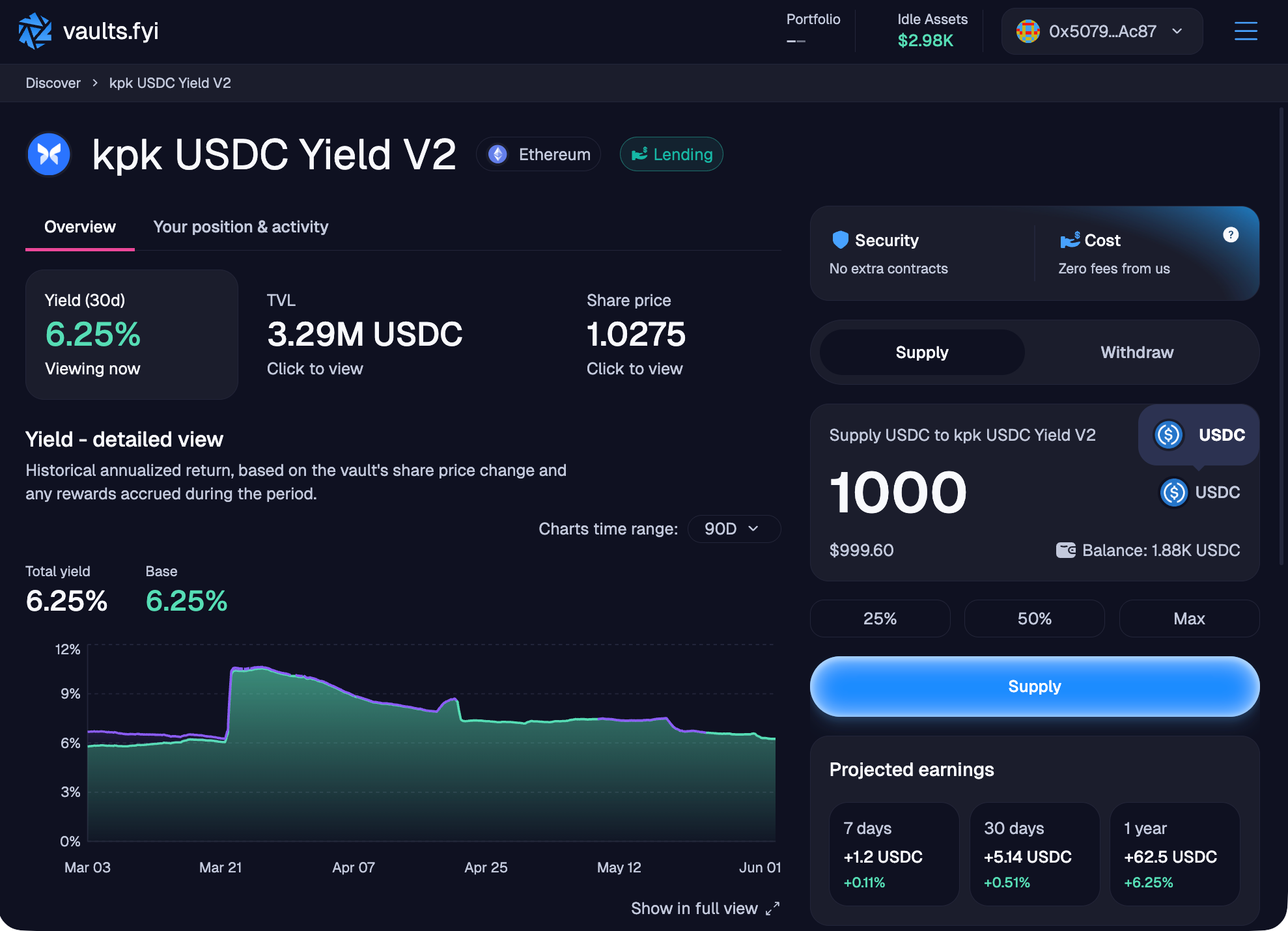
A single vault response from our API looks like this:
{
  "name": "KPK USDC Yield V2",
  "curator": { "name": "KPK" },
  "protocol": { "name": "morpho" },
  "apy": {
    "30day": { "base": 0.0625, "reward": 0, "total": 0.0625 }
  },
  "tvl": { "usd": "32912293" },
  "score": { "vaultScore": 67.4 },
  "flags": []
}
Deposits and withdrawals
When a user selects a vault and confirms a deposit, vaults.fyi builds the transaction and returns unsigned calldata ready to pass to any wallet:
{
  "actions": [
    {
      "to": "0xbeef0e0834849aCC03f0089F01f4F1Eeb06873C9",
      "data": "0x6e553f65...",
      "value": "0",
      "chainId": 8453
    }
  ]
}
Each action is passed to the wallet layer for the user to sign. With Privy, that is two lines of code:
const { sendTransaction } = usePrivy()
for (const action of actions) {
  await sendTransaction(action)
}
The flow is fully non-custodial. Funds move from the user's wallet directly to the protocol contract: your app never holds them, and vaults.fyi never touches keys or broadcasts. This works with any wallet infrastructure: Privy, Dynamic, Openfort, or any EIP-1193 provider. The signing boundary stays entirely with your stack.
Withdrawals follow the same pattern. For instant-redeem vaults the calldata is returned immediately. For vaults with a queue or exit delay, the API surfaces the current step so your UI can communicate the timeline to the user accurately.
Position data updates in real time after a confirmed deposit. Balance, accrued yield, and transaction history are all available per wallet, per vault, so you can build a full account view without any additional indexing work on your side. Full API reference at docs.vaults.fyi.
Filtering the universe to build your menu
The vault search endpoint accepts curator, protocol, asset, and network filters so you can build your menu programmatically rather than hardcoding vault addresses:
GET /v2/detailed-vaults
  ?assets=USDC
  &curators=steakhouse+financial
  &protocols=morpho
  &networks=base
  &sortBy=apy30day
When Steakhouse Financial deploys new vaults on Morpho on the Base network, they appear in this response automatically. Your integration does not change.
Monetization
Offering yield is a revenue opportunity. vaults.fyi gives integrators two ways to earn on the balances they route.
Attribution and revenue sharing. Our attribution system lets every transaction carry an ID that travels with the position and indexes against every event it generates. This powers per-partner reporting and revenue splits with protocols and curators, and gives you all the tooling you need to track and claim what you earn. It is one optional field on the existing request, off by default. Full details at docs.vaults.fyi/use-cases/for-wallets-and-apps.
Protocol-native fees. Some protocols allow integrators to add a fee directly at the protocol level. Morpho v2 and Aave v4 both support this: a fee parameter on the deposit transaction that routes a portion of yield to an address you control, without any off-chain arrangement required. vaults.fyi exposes this in the transaction-building surface for supported protocols.
Both mechanisms can run simultaneously. For most integrators, starting with attribution and adding protocol-level fees once volume justifies it is the right sequence.
A market that keeps moving
Yield is becoming a feature users come to expect, and the market delivering it is evolving quickly.
Tokenized real-world assets are accelerating. Short-term Treasuries, money market funds, and institutional credit are all moving onchain. The number of RWA-backed yield options available to integrators today is a fraction of what will exist in two years, across more assets and more chains.
Protocols are upgrading on shorter cycles. Aave v3 is live across a dozen networks; Aave v4 is in deployment. Morpho Midnight introduces new vault mechanics. Each upgrade brings new parameters, new collateral types, and in some cases new integration surfaces. Staying current is a real engineering cost for any team trying to maintain direct protocol integrations.
Curators are launching new products continuously. A Gauntlet vault that is the best risk-adjusted option today may be surpassed by a new product from Steakhouse or KPK next quarter. Without the flexibility to update your menu, you are locked into yesterday's best option.
vaults.fyi tracks all of this so you don't have to. Our team maintains adapters across every major protocol, ingests new vaults automatically from factory contracts, and publishes risk flags when incidents occur. You stay on the current menu. We handle what's underneath it.
About vaults.fyi
vaults.fyi is the API for onchain finance, delivering standardized market data, position tracking, real-time APY, reputation scoring, and transaction building across 90+ DeFi protocols.
Kraken, Gauntlet, KPK, and Offchain Labs build on the vaults.fyi API because of its data accuracy and developer experience: accurate data across protocols, designed to fit existing signing infrastructure without custody changes.
Get started at portal.vaults.fyi to get your API key and begin your free trial.